
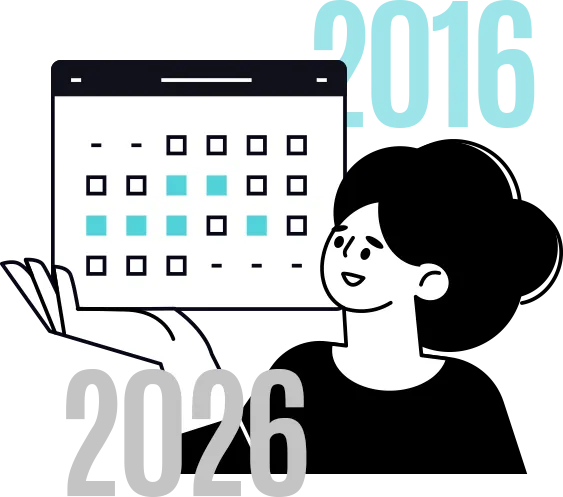
If your business website was created 5 or 10 years ago, it might not feel particularly old. After all, your business probably still provides many of the same services. Your logo may not have changed. The website still loads, the telephone number is correct, and the contact form might even work.
To put it into perspective, between 2016 and 2026 the UK has had seven Prime Ministers: David Cameron, Theresa May, Boris Johnson, Liz Truss, Rishi Sunak, Keir Starmer and Andy Burnham.
The world has changed
A LOT.
And so have websites. Your website may be older than it looks to you
One of the problems with an older website is familiarity. When you have seen it hundreds of times, you stop noticing its shortcomings.
A new visitor sees it very differently.
They land on your site with no previous knowledge about your business and quickly form an impression based on what they see on the screen. This is known as the 3 second rule. If the website looks dated, is difficult to use or does not clearly explain what you offer, that impression can affect how they view the whole company.
The result is your hard-earned visitor bounces. Or in other words, leaves immediately.
It makes visitors wonder:
Let’s take a look. Your customers are not using the same technology to look at your website. You probably do not drive the same car you had ten years ago. You almost certainly do not use the same phone or computer.

Their devices are faster, their screens are bigger and sharper, and their expectations are much higher. They are used to websites that load quickly, work easily and provide clear answers without making them search.
If everything else has moved forward but your website has stayed the same, visitors will notice.
A website created for the technology and expectations of the last decade may no longer provide the experience people expect today.
Your business probably provides an excellent service and has decades of experience. However, visitors cannot see that experience unless your website demonstrates it effectively.
An old-fashioned website will make a good business appear behind the times.
Ten years ago, responsive website design was already important. Since then, mobile browsing has become a normal part of almost every business buying journey.
Your potential customers may first visit your website on a phone. Even when a final decision is made on a desktop computer, the first impression may have happened on a much smaller screen.
A modern website must be genuinely easy to use on a phone, not simply a smaller version of the desktop site.
Written content must be easy to read. Buttons should be easy to tap. Menus should be straightforward, pages should load quickly and visitors should not need to pinch and zoom to find information.
A website built before 2016 may technically work on a phone but deliver a frustrating experience.

Devices themselves have changed significantly. Ten years ago, websites were being designed for very different screens and technology.
Phones now have larger, sharper displays. Tablets are used for both personal and professional work. Laptops come in a wider range of sizes and higher resolutions, while high-resolution desktop monitors have become commonplace.
Older websites are noticeable to visitors immediately. They appear narrow, cramped or oddly spaced on modern screens. Images may look blurred, page layouts can feel rigid and important content may be pushed into the wrong place.
A current website will adapt smoothly to different screen sizes rather than merely remain functional on them.
Web design trends come and go, but this is not simply a question of fashion. Modern business websites generally use clearer layouts, stronger headings, more space and better-quality images.
They make it easier for visitors to scan a page, understand the message and decide what to do next.
Visitors expect a website to answer their main questions quickly. What does the company do? Who does it help? Why should they choose it? What should they do next?
If those answers are difficult to find, visitors can return to Google and try another business instead.
Website technology has advanced considerably in the last 10 years. Modern development can produce websites that are quicker, easier to manage and more reliable.
Images can be delivered in more efficient formats, pages can be built to load only what they need, and content management systems have become more flexible.
A slow website creates a poor first impression and gives busy visitors an easy reason to leave. A website that is ten years old may also depend on outdated software, unsupported plugins or old integrations.
Even if everything appears to work, maintaining it can become increasingly difficult.
Website security has always been important, but the risks have continued to develop.
Automated attacks can target websites of every size. Criminals are not only interested in large national organisations; smaller business websites can also be attacked, infected with malicious code or used to send spam.
An older website may contain software that is no longer supported or has not received security updates. It may also lack some of the safeguards now routinely included in professionally developed websites.
A modern website provides a stronger and more maintainable foundation.
A traditional business website often acted as an online brochure. It introduced the company, listed its services and displayed some contact details. That is no longer enough.
A good B2B website should help turn an interested visitor into a genuine prospect. It should understand what the visitor needs and guide them towards taking the next step.
That includes:
The objective is not to fill every page with aggressive sales messages. It is to remove uncertainty, build confidence and make contacting the business feel like an easy and sensible next step.
Your old website has not remained frozen in isolation. Over the last ten years, competing businesses have probably invested in clearer content, better photography, case studies, search engine optimisation and persuasive service pages.
A prospect comparing several suppliers might see broadly similar services and experience. The quality of each website can then influence which companies make the shortlist.
A dated website does not necessarily mean that you offer a dated service but visitors will subconsciously be make that connection.
Not necessarily.
Age alone is not the deciding factor. What matters is whether the website still represents your business properly and produces the results you need.
It is worth reviewing to check if:
Your website should be one of your most useful business development tools. If it is simply sitting online because it has always been there, it is time to reconsider what it could be doing for you.
Your business has almost certainly changed in this time. Your customers have changed, their expectations have changed and the technology they use has changed.
Your website should reflect the business you are today, not the business you were ten years ago.
If your business is based in Northamptonshire and your website was created before 2020, we can look at it and explain where you may be losing visitors and enquiries.
A straightforward website review can help you understand what is working, what is holding it back and whether a new website could deliver a better response.
If your website is 10 years old (or even 5 years old) and you think it needs a new lease of life, Contact Us.
We can talk it over and look at ideas of what you want to do with it.
